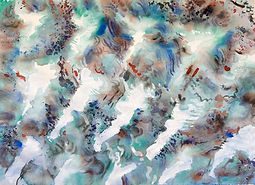
Holy contradiction
Holy Contradictions is a series composed of a poem and ten abstract watercolors. Together, they explore the shifting relationship between thought, emotion, gestural painting, and pictorial form. In a world that is more and more shaped by AI, what is the role of human consciousness? When all that counts are the volume of images dispatched by an artist, where is the room for the viewer to truly experience the work of art?
In this series, Fleur Thesmar paints from a deliberately neutral inner state. Her gestures echo natural movements, while her thoughts are held together by repeated words and refrains such as “Mother,” “Cherry tree, full of wind,” “Love and Despair”. These verbal anchors function as rhythms that shape the work as much as the movement of the brush itself.
This body of work emerged in response to reactions to Thesmar’s earlier nature-inspired paintings, which viewers described as either “oppressive” or “liberating.” These opposing interpretations led her to question: if semi-abstract landscapes created in a contemplative state can provoke such strong and contradictory responses, how powerful is the artist’s inner state in shaping what ultimately appears on the surface? Can the self expression of the artist be diminished to leave more room for the viewers?
The full series culminates in a poem dedicated to her mother, which invites the viewer to contemplation. Each verse corresponds to one or several painting:
Mother,
What do you see in my
Cherry tree, full of wind?
You seek the spirit hovering
Over the ripples.
Despair and hope crossed long ago,
And love is enough.
Let’s shift our pixels,
Stroll from the forest to the meadow,
To horizons full of harvests.
Lets join the choir and heroes,
Waltz and abandon our sorrows.
Through layered transparencies, the watercolors evoke the overlapping images of contemporary screens, where perception is blurred and ideas are interwoven with visuals. By correspondences between nature and spirit, memory and perception, the work seeks a dialogue with the viewer. What do they see, and what do they project?
This method of painting feels different in the context of contemporary arts, in the way the softening of the artist's presence is an experiment to create another type of dialogue with the public.